
Viture Luma vs Xreal One Pro: Value vs Immersion
Discover the features of Viture Luma ($399) with its 1500-nit brightness and focus dials, compared to the Xreal One Pro ($650) offering 57° FOV and X-Prism optics. Find out which provides a more immersive experience.
REVIEWXR
1/27/20266 min read
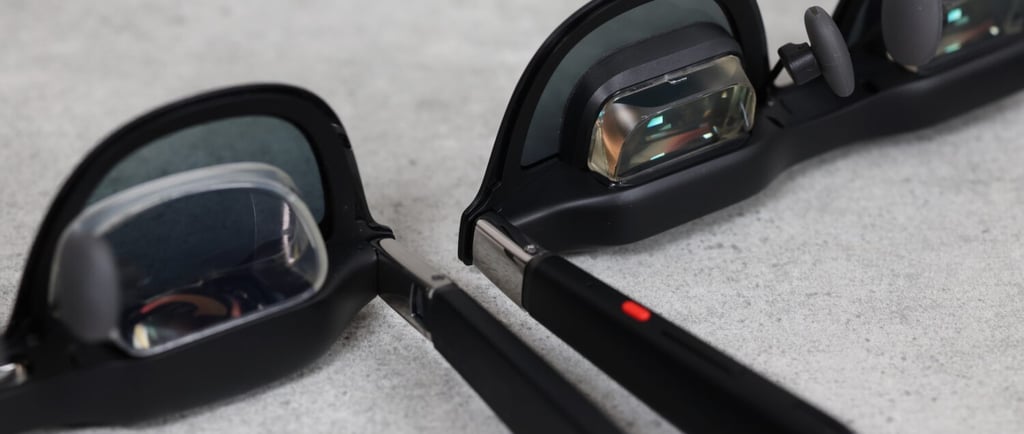
Viture Luma vs XREAL One Pro: Which AR glasses win the 2026 battle?
AR glasses are having their moment. Not the metaverse fantasy Meta burned billions chasing—practical, wearable displays you actually want to use. Two models dominate the conversation in early 2026: Viture Luma at $399 and XREAL One Pro at $650.
Both promise giant virtual screens, high-quality displays, and premium audio. One costs 63% more than the other. Does that price gap buy meaningful upgrades, or is Viture Luma the better value?
After CES 2026 saw smart glasses shift from experiment to enterprise infrastructure, consumer AR glasses are finally ready for mainstream adoption. If you're deciding which pair to buy, here's what actually matters.
Display quality: Sony panels in both, different execution
Both Viture Luma and XREAL One Pro use 0.55-inch Sony Micro-OLED displays with 1920x1200 per-eye resolution. That's 1200p "4K-like" quality, sharp enough that individual pixels disappear at normal viewing distances.
Brightness:
Viture Luma: 1500 nits through the optical stack
XREAL One Pro: 700 nits after passing through optics
Viture's brightness advantage is massive.
1500 nits means Luma works outdoors—direct sunlight doesn't wash out the image. XREAL One Pro's 700 nits is fine indoors but struggles in bright environments.
If you plan to use AR glasses on planes, in coffee shops, or anywhere with ambient light, Viture's brightness edge matters more than specs suggest.
Refresh rate:
Both hit 120Hz, smooth enough for gaming and video. No difference here.
Virtual screen size:
Viture Luma: 146-inch equivalent screen
XREAL One Pro: 171-inch equivalent screen
XREAL's larger screen comes from its wider field of view (more on that below). Bigger isn't always better—some users find 171 inches too large, forcing more head movement to scan content. Viture's 146 inches offers better information density for productivity tasks.
Field of view: XREAL's 57° takes the crown
This is XREAL One Pro's killer feature.
Field of view comparison:
Viture Luma: 50° FOV (estimated based on 146" screen)
XREAL One Pro: 57° FOV
Seven degrees sounds small. It's not. Field of view determines how immersive the experience feels and how much content fits in your peripheral vision simultaneously.
XREAL achieves this through its X-Prism optics—an industry-first design that eliminates stray light and reduces reflections compared to traditional "bird bath" optics used in most AR glasses, including Viture Luma.
X-Prism makes XREAL One Pro thinner and improves image clarity by cutting unwanted reflections visible on the front of the lenses. From a privacy standpoint, this also means people near you can't easily see what you're watching.
Viture Luma uses conventional optics. They work fine, but you'll notice more light bleed and slightly thicker frames.
Winner: XREAL One Pro. The X-Prism tech and 57° FOV justify part of the price premium.
Audio: HARMAN vs Bose—both excellent
Audio in AR glasses matters more than you'd think. Unlike headphones, spatial audio needs to sound natural while staying isolated enough that you're not annoying everyone nearby.
Viture Luma: HARMAN-tuned audio
Viture partnered with HARMAN for acoustic tuning. Reviews praise fuller, richer sound with solid bass response for open-ear speakers. The sound chamber design delivers clarity without leakage, even at moderate volume.
XREAL One Pro: Sound by Bose
XREAL partnered with Bose for professional tuning. Bose's expertise shows—balanced audio with excellent clarity and detail. The soundstage feels wider, which enhances immersion for movies and gaming.
Both are significantly better than Ray-Ban Meta's open-ear speakers or most smart glasses on the market. Neither requires external headphones for a satisfying experience.
Winner: Tie. HARMAN and Bose represent top-tier audio tuning. Preference comes down to personal taste—warmer (Viture) vs. more analytical (XREAL).
Optical adjustments: Viture's focus dial advantage
Here's where Viture pulls ahead for certain users.
Viture Luma includes adjustable focus dials for nearsighted users. If you have mild to moderate myopia, you can adjust the lenses to achieve sharp focus without wearing prescription glasses underneath. This is huge for comfort during extended use.
XREAL One Pro offers IPD (interpupillary distance) adjustment to match the spacing between your eyes. There are multiple size options (S for IPD 57-62mm, M for 57-66mm, etc.), ensuring proper alignment.
XREAL's IPD system is more technically sophisticated, but Viture's focus dials solve a practical problem: glasses-wearers can ditch their frames entirely.
Winner: Depends on your eyesight. Nearsighted users will love Viture's focus adjustment. Those with wider or narrower IPD need XREAL's sizing options.
Chipset and 3DoF: XREAL's X1 advantage
XREAL One Pro includes the X1 spatial computing chip, which delivers:
Native 3DoF (three degrees of freedom) head tracking with 3ms latency
On-device processing for stable virtual screen positioning
Smooth Follow mode (screen follows head movement naturally)
Compatibility adjustments without external hardware
The X1 chip is XREAL's proprietary silicon, designed specifically for AR glasses. It eliminates the lag and drift common in glasses relying on phone processing for spatial tracking.
Viture Luma offers 3DoF through the optional Viture Pro Neckband (sold separately, ~$200). Without the neckband, Luma is a "dumb display"—the screen is fixed relative to your head, moving whenever you move.
For media consumption (movies, videos), fixed-screen mode is fine. For productivity (multiple virtual monitors) or gaming, 3DoF makes a massive difference. XREAL includes it out of the box; Viture requires additional investment.
Winner: XREAL One Pro. Built-in spatial computing beats optional accessories.
Software ecosystems: SpaceWalker vs Nebula
Viture's SpaceWalker app:
Multi-screen productivity mode
2D-to-3D conversion (real-time for supported content)
Ambient mode (see-through transparency adjustment)
Works with SpaceWalker on macOS, Windows, and mobile
XDA called SpaceWalker "the best software in consumer-grade AR glasses." It's particularly strong for productivity—multiple virtual monitors arranged in 3D space, smooth window management.
XREAL's Nebula platform:
Spatial display modes (Body Anchor, Smooth Follow, Sideview)
AR Space for multitasking
Integration with XREAL Beam Pro (external device for standalone use)
Wide device compatibility (iPhone, Android, Mac, PC, Steam Deck, Nintendo Switch)
XREAL's ecosystem is more mature, with better third-party app support. Nebula works seamlessly across platforms, and the XREAL Beam Pro adds smartphone-free functionality (though it's a separate purchase).
Winner: XREAL One Pro. More polished software, better device compatibility, stronger ecosystem.
Price and value proposition
Viture Luma: $399
What you get:
1500 nits brightness (outdoor usability)
1200p Sony Micro-OLED, 120Hz
HARMAN audio
Focus dials for nearsighted users
146-inch virtual screen
SpaceWalker software (excellent for productivity)
What you don't get:
Built-in 3DoF (requires $200 neckband)
Wider FOV
X-Prism optics
XREAL One Pro: $650
What you get:
57° FOV (largest in consumer AR)
X-Prism optics (thinner, no stray light)
X1 chip with native 3DoF (3ms latency)
Bose-tuned audio
IPD adjustment
Mature software ecosystem
What you don't get:
Outdoor brightness (700 nits struggles in sunlight)
Focus adjustment for nearsighted users
The math:
Viture Luma alone: $399
Viture Luma + Pro Neckband (for 3DoF): $599
XREAL One Pro (3DoF built-in): $650
Once you add the neckband to Viture for comparable functionality, XREAL is only $51 more expensive—and you're getting superior FOV, better optics, and a more refined experience.
But if you don't need 3DoF (just watching movies or gaming in fixed mode), Viture Luma at $399 is unbeatable value.
Who should buy which?
Buy Viture Luma if:
You primarily watch movies, videos, or play games on Steam Deck/Switch
You want outdoor usability (planes, coffee shops, bright rooms)
You're nearsighted and prefer not wearing glasses underneath
You're on a budget and don't need spatial tracking
You value SpaceWalker's productivity features but won't use 3DoF
Best deal: Viture Luma at $399 standalone for media consumption.
Buy XREAL One Pro if:
You want the most immersive AR experience (57° FOV)
You need built-in 3DoF for productivity or spatial apps
You prioritize thin, refined hardware (X-Prism optics)
You'll use AR glasses across multiple devices frequently
Outdoor brightness isn't a priority (mostly indoor use)
You want the most polished software ecosystem
Best deal: XREAL One Pro if you need 3DoF—otherwise, Viture + neckband costs nearly the same.
The verdict
XREAL One Pro is the better AR glasses. Its 57° FOV, X-Prism optics, X1 chip, and mature ecosystem deliver the most complete experience. If you're serious about using AR glasses as a productivity tool or for immersive content, spend the extra $250.
Viture Luma is the better value for casual users. Its 1500-nit brightness, focus dials, and $399 price make it the smart choice for movies, gaming, and travel. You're not getting cutting-edge spatial computing, but you're getting an excellent display you can actually use outdoors.
If money isn't a constraint: XREAL One Pro.
If you want the best bang for buck: Viture Luma.
If you're comparing Viture + neckband ($599) to XREAL One Pro ($650): XREAL wins on hardware refinement, but Viture wins if outdoor brightness matters.
FAQ: Viture Luma vs XREAL One Pro
What's the biggest difference between Viture Luma and XREAL One Pro?
XREAL One Pro has a 57° field of view (largest in consumer AR glasses) and built-in 3DoF spatial tracking via the X1 chip. Viture Luma has higher brightness (1500 nits vs 700 nits) and costs $250 less, but requires an optional $200 neckband for 3DoF.
Can I use either AR glasses outdoors?
Viture Luma's 1500-nit brightness works well outdoors, even in direct sunlight. XREAL One Pro's 700 nits struggles in bright environments—it's best for indoor use.
Do I need prescription lenses for AR glasses if I'm nearsighted?
Viture Luma includes adjustable focus dials that accommodate mild to moderate myopia without needing prescription inserts or wearing glasses underneath. XREAL One Pro requires prescription inserts (sold separately) or wearing glasses under the frames.
Which has better audio: HARMAN or Bose?
Both are excellent. HARMAN (Viture) delivers warmer, fuller sound with good bass. Bose (XREAL) offers more balanced, analytical audio with wider soundstage. Preference depends on personal taste—neither requires external headphones.
What is 3DoF and do I need it?
3DoF (three degrees of freedom) tracks head rotation so the virtual screen stays stable in space rather than moving with your head. It's essential for productivity (multiple virtual monitors) and immersive apps. XREAL includes it; Viture requires the Pro Neckband add-on.
Can I use these AR glasses with my iPhone, Steam Deck, or Nintendo Switch?
Both work with USB-C devices that support DisplayPort output. This includes most modern iPhones, Android phones, Steam Deck, ROG Ally, MacBooks, and PCs. Nintendo Switch requires an adapter like XREAL Hub. Check device compatibility before buying.